Pick up a piano exam syllabus for the first time, and you’ll probably want to put it straight back down. Grades, piece lists, theory papers, scales, sight-reading, ear tests. It’s a lot.
Families searching for Piano lessons in Mississauga run into the same names almost right away: RCM, ABRSM, and some others. All these give students something to aim for. They just get there differently.
Some boards hand you a fixed list and expect you to follow it. Others let students choose more of their own music, and a few reward creativity too. Which one works depends on the student. Age counts, and so does taste in music. So does the reason they started learning.
What Is a Music Exam Board and Why Does It Matter?
Think of an exam board as a measuring stick. Without one, a student can play for years and never know whether they’re improving or just repeating the same songs. With one, there are clear levels and an assessment at the end of each.
Every board tests a little differently. Pieces and technical work show up almost everywhere, and most boards add sight-reading, ear training, and theory. The benefit is that students come away with well-rounded skills instead of a folder of memorised songs.
Structure helps plenty of people. A student who tends to practise only when there is a clear goal may find an upcoming exam a reason to stay on track. On the other hand, exams are not a requirement for learning piano well. Someone who simply wants to play favourite songs may have little interest in grades at all.
The Royal Conservatory of Music (RCM)
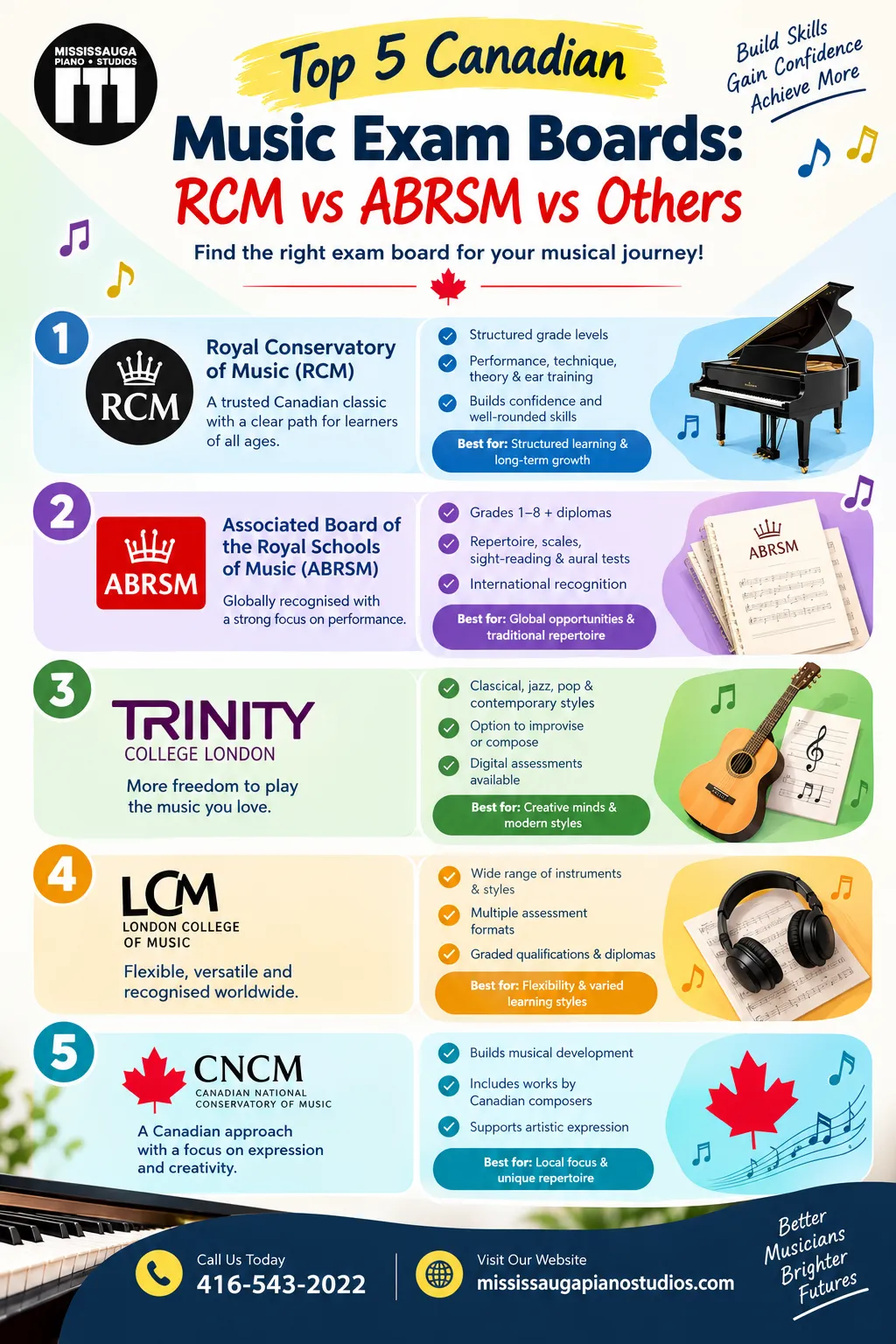
Most people in Canada have heard this. It is one of the longest-running exam systems. Its piano programme gives learners a fairly clear route from the early stages through more advanced study.
Parents usually like how clear RCM is. At each level, you can see exactly what your child needs to work on. Performance shares the stage with technique, sight-reading, ear training,
and musicianship, so lessons stay well-rounded. Students who like goals do well here. Passing a level shows them they’re improving, and younger kids love that.
Teachers get value from it too. A good instructor won’t just teach the exam pieces. They’ll use the syllabus to build technique, expression, reading, and confidence, and they’ll bring in music from outside the required list. If you’re looking at RCM piano exams, keep this in mind: the syllabus is a framework, not a replacement for broader musical development.
The Associated Board of the Royal Schools of Music (ABRSM)
It started out in the UK. Today it’s recognised in many countries, so it makes sense for students who could study or perform abroad down the line.
The piano grades run from 1 to 8. Higher-level diplomas sit beyond that. Every exam covers performance repertoire, scales, sight-reading, and aural tests. By the later grades, theory takes up much more space.
Plenty of learners go for ABRSM because of its global recognition and a grading system people already understand. Traditional repertoire and clear performance expectations? Those are exactly what it’s known for.
One thing to sort out early: not every board has the same exam availability. Check what’s on offer before you settle on a syllabus, because a qualification can look perfect on paper and still be a headache to book. And don’t let a big name make the choice for you. Weigh up the whole learning experience instead.
Trinity College London (TCL)
Plenty of piano students don’t want every practice session to be classical. Trinity College London leaves a bit more room to play what you actually enjoy, and you still end up working toward a qualification people recognize.
The exam repertoire isn’t tied to one style. You’ll find classical, jazz, pop and contemporary pieces on the list. Depending on the exam and syllabus you pick, there may also be a chance to improvise or compose. That’s good news if you like learning set pieces but also want to try making a bit of music your own way.
If you want an exam that lets your personality come through, Trinity’s worth a look. It also offers digital assessment for eligible exams, including recorded performances. Requirements change, so check the current ones and see which format works for you.
London College of Music (LCM)
London College of Music is another way to put a formal measure on your progress. Its exams cover a lot of instruments and styles. Graded qualifications suit developing players, and diplomas are there for anyone who wants to keep going further.
Busy families may like the choice of assessment formats on eligible exams. Some students feel fine performing in an exam room. Others do better recording at home. What’s on offer depends on the qualification, so read the details before you make any plans.
LCM probably isn’t the first name that comes up when people compare music exams in Canada. Still, it’s worth raising with your piano teacher. Look at the repertoire, the exam requirements, and how the assessment works, then decide if it fits what you’re aiming for.
Canadian National Conservatory of Music (CNCM)
Would you rather look at a Canadian exam system? The Canadian National Conservatory of Music is one to consider. CNCM puts weight on musical development, expression, and repertoire that includes works by Canadian composers.
That focus can suit students who want to build their skills without treating every lesson like a race to the next grade. Playing music by Canadian composers also brings in pieces many students wouldn’t otherwise come across.
Families and teachers who like a more local approach to music education may find CNCM a good match. Like any exam board, it needs a proper look. Go through the current syllabus and talk to your teacher about how it lines up with the student’s ability, interests, and long-term plans.
How to Choose the Right Piano Exam Board
Forget about finding “the best” board. Begin with the learner.
- Start with the goal.
Think about what the student wants out of this. Some need motivation. Others want a formal assessment, clear progress, or a qualification that lasts. The answer shapes everything else. - Look at the repertoire.
Read through the syllabus and imagine them playing those pieces. If they like the music, practice stops being a chore. That’s how it usually goes. - Check the full assessment.
Don’t stop at performance. Exams also cover technique, theory, sight-reading, ear training, and more, so give those a proper read. - Ask the teacher.
Teachers handle these syllabuses all the time. Ask what preparation involves and whether it fits the student at this stage. - Think ahead.
An easy option now may not hold up a few levels down the road. Think about where the student wants to go with it.
Why the Right Teacher and Studio Still Matter
The exam board gives a student a framework. The teacher gives it life. Same syllabus, different teacher, and the whole experience can change.
Strong teaching isn’t about getting someone to play a few pieces on exam day. It’s about musicianship. Problems with rhythm, technique, reading, interpretation, or confidence should get attention early, before they grow into something bigger.
When researching, think about teaching quality, instructor experience and flexibility, along with the board itself. Personalised lessons matter at Mississauga Piano Studios, because children, teenagers and adults don’t learn at the same pace. Lessons can be in-person, in-home, or virtual, depending on what the student needs.
Choose the Pathway That Fits the Learner
Picking between RCM, ABRSM and the other boards doesn’t have to feel like a contest. RCM works well for learners after a structured Canadian pathway. ABRSM tends to suit learners who value international recognition. Trinity, LCM and a few other boards work well for students who’d rather have different repertoire or assessment choices.
Nothing matters more than suitability. The learner’s goals, interests, pace and plans for the future should guide the choice. Go through each syllabus carefully and talk with a teacher who knows the requirements. Then make the call.
Not sure which pathway fits your current level and goals? Contact us, and we’ll go through your options and help you find a sensible place to start.
FAQs
What are the main music exam boards for piano students in Canada?
The main music exam boards for piano students in Canada are the Royal Conservatory of Music (RCM), ABRSM, Trinity College London, London College of Music, and the Canadian National Conservatory of Music. Each offers graded levels assessing repertoire, technique, sight-reading, and ear training, but they differ in repertoire choice, international recognition, and assessment format.
What is the difference between RCM and ABRSM for piano?
RCM and ABRSM differ mainly in origin and recognition. The Royal Conservatory of Music is a Canadian system with a clear, structured pathway and strong emphasis on technique and musicianship. ABRSM began in the UK, offers piano grades 1 to 8 with diplomas beyond, and suits students who value international recognition and traditional repertoire.
Which piano exam boards let students play music they enjoy?
Trinity College London gives piano students broad repertoire choice, with classical, jazz, pop, and contemporary pieces on its lists. Depending on the syllabus, students may also improvise or compose. Trinity also provides digital assessment for eligible exams, which suits students who prefer recording performances over an exam room.
How do you choose the right piano exam board?
Choosing the right piano exam board starts with the student's goal, not the board's reputation. Review each syllabus's repertoire, check the full assessment, including technique, theory, sight-reading, and ear training, and consult the piano teacher. Consider long-term plans, since an easy option now may not suit later grades.
Do piano students need to take exams?
Piano students do not need to take exams to learn well. Exam boards like RCM and ABRSM provide clear levels, goals, and well-rounded skills in technique, sight-reading, and ear training, which motivates many learners. Students who simply want to play favourite songs may skip grades, and a skilled teacher can still build musicianship without formal assessment.