Fall changes the calendar for piano families across the GTA. School restarts, practice routines reset, and for RCM candidates, the countdown to the next exam session begins. This is the moment when a clear plan matters most. Many parents searching for piano lessons in Mississauga this time of year are really asking one question: when does the school year start mattering for RCM exams? The short answer is now. Lessons resume in early September, and the winter RCM practical session runs through December and January, with registration closing several weeks in advance. At Mississauga Piano Studios, this planning conversation happens with every family at the start of fall term, because the RCM calendar rewards early decisions and punishes late ones.
The RCM Exam Calendar Has Multiple Sessions Per Year
Many parents assume RCM only offers a winter or summer exam. In reality, the Royal Conservatory of Music runs multiple practical exam sessions throughout the year (such as the late-year November/December block and the major spring/summer sessions). Theory exams run on a separate schedule with dedicated sitting dates twice a year.
This matters because choosing the wrong session is one of the most common and most avoidable mistakes in RCM planning. A student who’s ready by late fall might actually be a better fit for a later session once school workload is factored in. A qualified instructor tracks a student’s real readiness against the calendar rather than defaulting to whichever session comes next.
Theory becomes non-negotiable once a student reaches Grade 5 practical. From that level onward, RCM requires a matching theory credential as a co-requisite, so families need to track theory progress alongside repertoire, not as an afterthought a few weeks before exams.
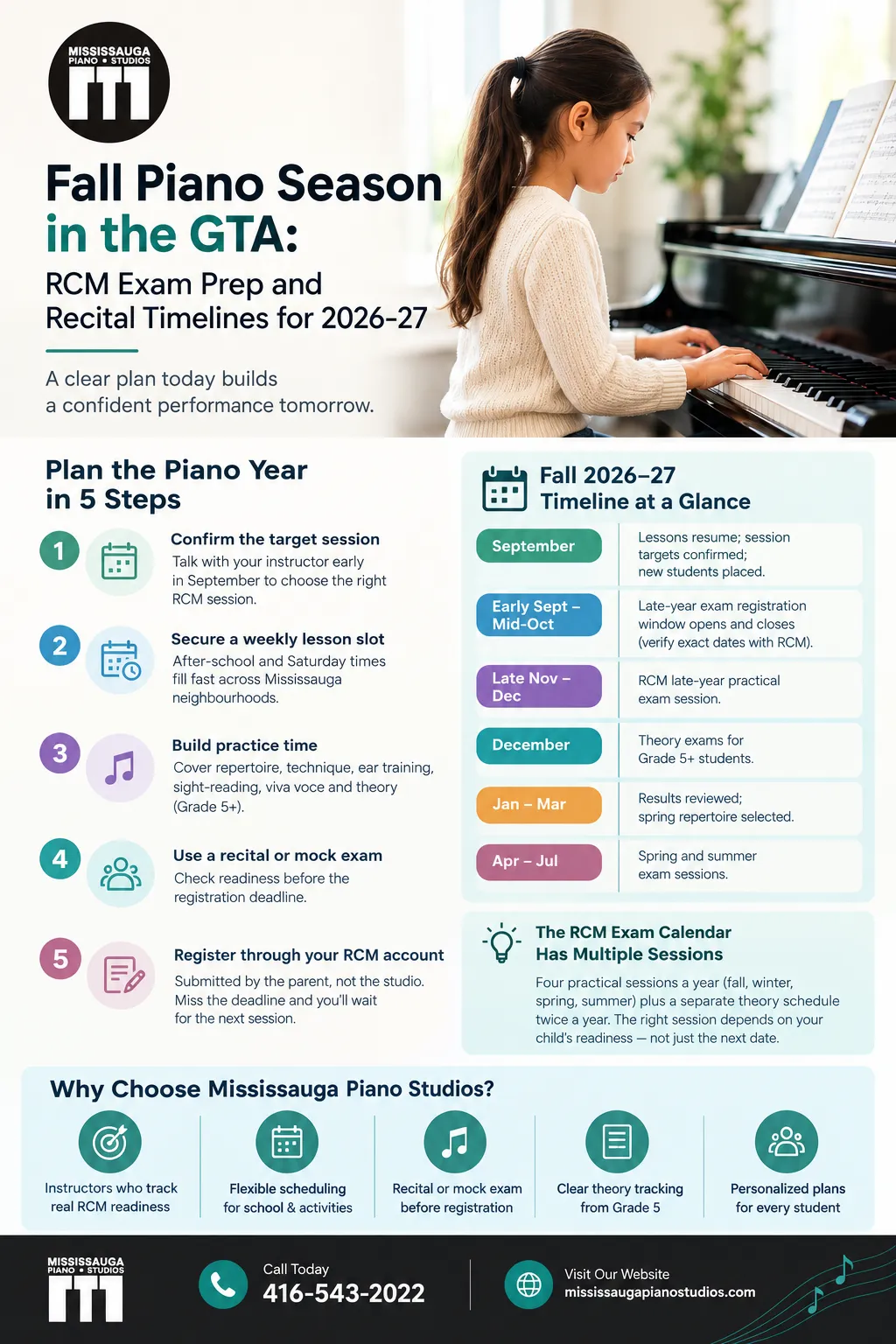
How to Plan the Piano Year in 5 Steps
- Confirm the target session with your instructor. A placement conversation early in September clarifies whether the late-year or spring session genuinely fits the student’s current preparation.
- Secure a weekly lesson slot early. After-school and Saturday times across Mississauga neighborhoods like Streetsville, Erin Mills, and Port Credit fill fast. Waiting until October usually means settling for a less convenient time.
- Build practice time around the exam’s real requirements. RCM assesses repertoire, technical work, ear training, sight-reading, and viva voce questions, plus theory from Grade 5 up. Younger students (Grade 1–4) do well with 20 to 30 minutes of daily practice; intermediate and advanced students (Grade 5–10) need 40 to 60 minutes.
- Use a recital or mock exam as a readiness check. A performance run-through before the registration deadline reveals whether a student is truly exam-ready or needs another session to prepare properly.
- Register through the family’s own RCM account before the deadline. Registration is submitted by the parent, not the studio. Missing the window means waiting for the next session, often months later.
Fall 2026–27 Timeline at a Glance
|
Month |
What Happens |
|
September |
Lessons resume; session targets confirmed; new students placed |
|
Early September – Mid-October |
Late-year exam registration window opens and closes (verify exact dates with RCM) |
|
Late November – December |
RCM late-year practical exam session |
|
December |
Theory exams for Grade 5+ students |
|
January – March |
Results reviewed; spring repertoire selected |
|
April – July |
Spring and summer exam sessions |
Why Exam Prep Isn’t the Same as Regular Lessons
Weekly lessons build overall musicianship at a steady pace. Exam preparation shifts the focus onto specific, gradable skills in a shorter window:
- Repertoire moves from learning to memorizing and refining to a performance standard.
- Technical work gets drilled to the exact tempo and articulation the RCM syllabus expects.
- Ear training and sight reading need dedicated practice time of their own, since repertoire practice alone won’t build them.
- Theory tracking becomes essential from Grade 5 onward, since a missed theory credential can hold up an otherwise strong result.
Experienced instructors restructure lesson time in the weeks before registration closes to cover these areas properly, instead of spending the whole lesson on repertoire.
What to Look for in a Mississauga Piano Studio This Fall
- Instructors who track each student’s actual readiness against the real RCM calendar
- Flexible scheduling that works around school extracurriculars
- A recital or mock exam built into the term before the registration deadline
- Clear theory tracking starting well before Grade 5
Start the Season With a Clear Plan
Fall sets the tone for a student’s entire RCM year, and the families who start early are the ones who walk into exam day prepared instead of scrambling. At Mississauga Piano Studios, every student gets a session plan built around their real progress, not a guess at what deadline they might hit. Contact us to book a placement lesson and map out the right RCM session for your child this fall.
FAQs
How many RCM piano exam sessions happen each year?
RCM runs four practical sessions a year: fall, winter, spring, and summer, along with a separate theory exam schedule that runs twice a year.
When should my child start lessons for the fall RCM session?
Lessons should start in early September, since fall registration typically closes about two months before exam dates begin in late October.
Does my child need to take a theory exam too?
Yes, starting at Grade 5 practical, RCM requires a matching theory exam as a co-requisite, so theory needs to be planned alongside repertoire well in advance.
What if we miss the RCM registration deadline?
The student moves to the next available session, since RCM doesn't offer late registration. A missed fall deadline usually means rebooking for winter or spring.
How much should my child practice during exam season?
Younger students preparing for Grade 1-4 should practice 20 to 30 minutes daily, and intermediate to advanced students preparing for Grade 5-10 should aim for 40 to 60 minutes daily.